

Is it you?
Who loves even when there is no love left to give?
You.
Who knows deep down in their heart that as long as two people are committed to each other, love conquers all?
You.
Who believes that everyone deserves to be loved, no matter where they come from and what they have been through?
You are a Love Devotee. Contrary to popular opinion, you jealously guard your heart; for you’ve been burned too many times. One wouldn’t necessarily say that you easily fall in love, but when the right person comes along and shows themselves to be the one you’ve been looking for? Goodness, you give it your all. What could make you give up on someone you looked in the eyes and said, ‘I love you’ to? Those words mean a lot to you. In your world, love shines as light in the darkness. It gives health to sickly bones and hope to the brokenhearted. No matter how hard things get, love will always be in your heart, to give an animal, a friend, or someone you may barely even know. That’s how easy it is for you to love——and be loved.
Is it you?
Who wants to make people feel comfortable around them?
You.
Who needs to show others that they are respected and valued?
You.
Who likes to listen to and validate others, longing for relationships that are genuine, enduring and meaningful?
You are a diplomat, a skilled peacemaker and harmoniser. You follow the Golden Rule in all your relationships: Do unto others as you would have them do unto you. You are decent, respectful, honest and transparent. You will often go with the flow if you feel like it will be more profitable for the group. That doesn’t mean you are a doormat or lacking in character——far from it. You simply think that sometimes the situation is not about you. You don’t mind taking a step back and letting others shine; on the contrary, you will gladly help them do so and cheer them up along the way. Whilst you can be competitive, you don’t need to win at all costs; you hate cheating or unfairness. You pride yourself on how well you get along with others, even though you may not be all that extroverted.
Is it you?
Who hates leaving questions unanswered, no matter if they impact them directly or not?
You.
Who will not let anyone fool them, relentlessly investigating difficult situations until they get to the bottom of the issue?
You.
Who clutches the truth with their teeth like a lion does its prey?
You are a Truth Seeker. You can’t stand people whose words can’t be trusted. You make a pledge with the full intent to uphold it, and you will jump through hoops to make sure you do not let others down. One sure way to lose your friendship is to lie to you repeatedly. You think deeply and intently about most things in your life. A lot of things often go through your mind at the same time, but it doesn’t restrict your capacity to focus and function effectively. You often reach random epiphanies about your musings at the most unexpected time. You love gazing into others, the future and yourself.
Is it you?
Who is always in touch with their intuition?
You.
Who values facts whilst knowing that there is often more to the story than meets the eye, that pure facts may not always readily expose?
You.
Who can pick up on the emotional temperature of a room and navigate it with astuteness and finesse?
You are emotionally intelligent. You have learned to trust your gut; it has probably gotten you out of serpentine situations before. You can see what others don’t. You understand that nothing is black and white, and true life unfolds in the grey. A situation may seem emotionally complex to others, but it’s not that complicated to decipher for you. You are gifted with the ability to temporarily suspend your personal worldview and adopt another person’s to understand their perspective. You may not share their stance, but that won’t stop you from having compassion for it. You may have wondered if you would make a good psychologist, for you usually understand why people do what they do.
Is it you?
Who will always make time to help a friend?
You.
Who struggles with saying ‘no’ and is always willing to share what they have with others?
You.
Who finds greater pleasure in giving than receiving, often doing so to their own detriment?
You are selfless. Helping others doesn’t take from you, but rather makes you feel good. You don’t mind giving away something you cherish, especially if you think that someone else needs it more than you do. You readily shoulder the burden of those around you, without it feeling like an obligation. May it be listening to a friend’s woes all afternoon, intervening in case of an emergency, or assisting a random stranger with their bags at the train station, if you have a free hand, you will lend it. Turning your back on others makes you feel guilty, even when it is perfectly justified for you to do so.
Is it you?
Who, despite their propensity to care for others, doesn’t seem to do the same with themselves?
You.
Who will readily go on a soul-searching journey, always on a quest for self-development?
You.
Who can’t help but doubt themselves?
You introspect and self-criticise. You don’t hate yourself——far from it. But you will question why you aren’t the better person that you think you should be. When something goes wrong, you will look inward first, pondering, ‘Is it my fault? What could I have done differently to get another outcome?’ You must right the wrongs in your life. To you, mistakes aren’t just mistakes; they are failures you must amend the next time. You set high standards for yourself and can feel quite disappointed in yourself when you aren’t able to uphold them. ‘I need to forgive myself for having allowed that to happen,’ is something you think more than you should. And when you realise it, you may feel bad for being that hard on yourself.
Is it you?
Whose kindness people often mistake for a weakness?
You.
Who can bear heavy psychological burdens for a sustained period of time without complaint?
You.
Who is gentle even when they know others will use against them, and patient even when they have every right not to be?
You are patient and resilient. Your tender heart isn’t something you are blind to. You will tolerate, endure, and give without expecting anything in return, not because you are naive, but because it is who you have chosen to be. You let go of injustices against you not because you can’t fight, but because you choose peace over war. Your choices are yours, and your character is in your control.
You live your life in accordance with your personal values and in harmony with others, even if you have to be the bigger person in most situations. Your kind-heartedness is what you consider one of your greatest virtues, no matter who may think they are exploiting it. But you don’t necessarily recover from abuse overnight. You feel it deeply, take the time to process it, and you somehow make your way forward through sheer conviction. That’s a powerful form of strength. But if you aren’t careful, it’ll leave you running on fumes, because you rarely give yourself permission to rest.
Is it you?
Have you answered ‘Me’ to the questions above and identified your behaviour in many of these descriptions? If so, then Hurrah! As the highest-ranking Patron of Holiness in the Cult of Empathy, I am pleased to induct you into the Hall of Saints!
You are part of the group represented by the last Figure of our mystery, Figure 8:
The Inner Self of an Empath
Your are very likely an Empath. You were either born that way, or you developed into such an emotionally charged person after having been put through the same unstable childhood environment that led to the formation of a narcissist. We shall explore the psychology behind such an environmental adaptation in a future article.

The figure shows two rings of the soul, reflecting the Empath’s heightened emotional awareness. They are more aware of what goes on in people’s souls (i.e. their minds, wills and emotions) than a non-empath. Not only does this awareness manifest as a greater sensitivity to the emotional states of those around them, but it also leads to a higher focus on the individual’s own Inner Self.
This focus on the self is not narcissistic. It is not done to inflate the ego and be conceited, but rather to improve the Inner Self’s virtue——as perceived by the Empath’s value system and emotional conditioning. Indeed, it is mostly an unconscious psychological exercise. That’s why empaths tend to have lower self-esteem and be much more self-critical and self-doubting than non-empaths.
An empath is more likely to know and describe how they feel about a situation than a non-empath. They are also more likely to sense or be able to interpret how another person feels about a situation than a non-empath. They usually adapt to their environment, navigating different emotional circumstances with ease——not in a calculative or manipulative way, but because of that natural sensitivity to others and themselves.
The Empath’s Innate Self-regulation
Most non-empaths have narcissistic traits that are strong enough to keep them from exhibiting the behaviours attributed to the Empath above. Although all empaths also have narcissistic traits, their empathic traits far outweigh the narcissistic ones.
Therefore, to support the functioning of their more prominent empathic traits, the Empath’s psyche equips itself with an invisible emotional thermometer that causes them to self-regulate to a considerable extent. This innate, mostly unaware compulsion in the Empath to self-adjust seeks to achieve one thing: Harmony. This harmony expresses itself in three ways:
(1) Safety: The Empath needs to be in harmony with their environment, especially when faced with unknown or hazardous ones that they must navigate or survive.
(2) Affability: The Empath needs to be in harmony with others. They have a desire to maintain peace and cohesiveness in all their inter-personal relationships.
(3) Integrity: The Empath needs for their actions to be in harmony with their personal values. They devote themselves to walking the talk and not straying from their moral standards.
I call these three objectives the Empath’s Golden Balance of Harmony, or just the Golden Balance. The Empath’s self-regulation is ever-present. It works as a natural guide in the Empath’s Inner Self, shaping how they lead their lives to establish and maintain the Golden Balance.
A non-empath can feel very satisfied and emotionally fulfilled without the Golden Balance——not the Empath. The Empath constantly strives to optimise their lives, usually adjusting their own behaviours first, to attain the Golden Balance. They do this unconsciously, not because they think they are better than others, but because that’s just what their Inner Self requires to feel peace and contentment.
One objective in the Golden Balance will usually be more important than the other, leading to varying emotional responses in a given circumstance, influenced by the Empath’s belief system and other personality traits. This variance in importance of the three objectives is what I call the Priority Mix. The degree to which the Empath will be willing to self-regulate to achieve the Golden balance will also vary. I call this the Regulatory Level.
If a situation requires a high Regulatory Level that the Empath is not willing to subject themselves to, they will use the last resort to achieve or maintain their Golden Balance: Withdrawal. Withdrawal could be physically removing themselves from a scene to avoid further disruption to the Golden Balance, or emotionally detaching from a situation to achieve the same result.
Although the Priority Mix and the Regulatory Level will vary depending on the Empath’s personality and belief systems, they will remain mostly constant in each individual. Thus, you can expect an Empath to act in a predictable way in all their relationships, as their Inner Self utilises a standard Priority Mix and Regulatory Level proper to the individual.
Necessary Evil #6: Acknowledging That You Are an Addict.
The Empath’s self-regulation mechanism will alter when faced with a situation that deeply threatens their capacity to achieve the Golden Balance. An external stressor can temporarily cause the Empath’s default Priority Mix and Regulatory Level to shift, often returning to normal once the stressor is removed. But when the Empath enters a period of sustained devaluation in a narcissistic relationship, it goes further than just a temporary shift.
In addition to the impact of the emotionally demanding and erratic nature of a narcissistic dynamic on the Empath’s ability to attain the Golden Balance, the Empath also has an addiction to the Narcissist. The aspect of the Narcissist that the Empath is addicted to is the Narcissist’s supreme ability to trigger and sustain Trauma Bonding.
Trauma Bonding is a cycle of abuse (physical or emotional) that creates a strong attachment between the perpetrator of the abuse and their victim. This bond is reinforced by periods of love and affection, and then periods of devaluation and abuse. Unlike healthy emotional connections, which involve consistency, emotional safety, and mutual respect, trauma bonds are built on power imbalances and turbulent cycles of abuse and affection.
Therefore, the Empath’s addiction to trauma bonds will extend to pathological narcissistic dynamics in general. But the Narcissist remains the most apt to uphold this behaviour, thus will always be the Addiction’s primary target as a source to feed itself.
Trauma Bonding is the Addiction’s fuel. The Addiction in the Empath seeks a narcissist to trauma-bond to the same way that narcissism in the Narcissist seeks an empath to draw fuel from.
When the Addiction detects an opportunity to trauma-bond, it arouses the Empath’s Emotional Thinking, causing not a mere shift, but a total disruption of the Empath’s natural Priority Mix and Regulatory Level. I call Emotional Thinking the Treacherous Seductress because that’s what it does; it seduces to betray——just like the Narcissist.
‘He hath eaten me out of house and home, he hath put all my substance into that fat belly of his: but I will have some of it out again,’1 saith the Empath about Emotional Thinking.
In effect, Emotional Thinking is like a virus that penetrates the Empath’s emotional thermometer and takes over its self-regulation system. Its goal is to keep the Empath engaged with the Narcissist as long as possible to feed the Addiction. Hence, it causes the Empath’s natural inclination to self-regulation to go rogue, making the Empath illogically subservient to the Narcissist——sadly, sometimes unto death.
Emotional Thinking is the Enemy Within. It is able to turn the Empath’s whole emotional system upside down. But there’s good news! If you are an empath, you have a natural tendency to self-reflect, so becoming aware of the presence of Emotional Thinking in your Inner Self and working on your addiction is something you will readily want to do——unlike the Narcissist and other addicts of say, hard drugs.
A phenomenon not to be confused with Emotional Thinking is Post-Traumatic Stress Disorder (PTSD). PTSD is another element that wrecks the Empath’s emotional thermometer. Indeed, PTSD causes the Empath to lose control of their emotional state, disrupting their innate self-regulation capacity. This leads the Empath down paths of emotional agony and psychological disconcertment, hindering the Empath’s ability to achieve the Golden Balance, even when those three needs are objectively being met.
The Internet
I have found that the Internet, its sensory conditioning and addictive tendencies negatively influence my Golden Balance. Social Media specifically has not been a good thing for me——at all.
In early 2021, I decided to delete my social media accounts, leaving only YouTube and Reddit. A year later, I decided to leave both platforms, too. I returned to YouTube in 2023 with a ghost profile I used to watch my favourite podcasts and lectures. In 2024, I deleted instant messaging apps like WhatsApp (and its groups, channels, stories, etc). In 2026, I am ready to ditch the smartphone. I am extremely close to purchasing one of those old telephones from the 80s that were called ‘Cellular Phones’, weighed 30 kilograms and could barely fit in an adult’s hand from brands that the TikTok generation would never imagine existed in the past. Remember them?

In hindsight, I understand that Social Media was an external stressor hindering my ability to achieve the Golden Balance, and my self-regulation mechanism was not willing to continue ‘spending credits’ of my Regulatory Level on trying to handle that. Affability (online) went down on my Priority Mix, as it focused on dealing with the effects of the narcissistic abuse I was trying to navigate at the time, i.e. Safety. So it reached for the last resort: Withdrawal.
It is no surprise that it was a few months after my first round of exits from Social Media in 2021 that I came to theknowledge of narcissism, found H.G. Tudor’s work, and realised how much Narcissists had impacted my life. The constant emotional stimulation, dopamine shots, and aroused Emotional Thinking from my unwitting interactions with narcissists online reduced and my thoughts cleared up. I started asking myself deeper questions about my relationships (know a thing or two about that, right?) and had more time to do some research about it. Today, I treat Social Media like any other internet resource. I take what I want from it, then exit.
Discover More From The Antinarc
On empaths, narcissists, psychopaths, and their relationship dynamics. Dance to the tune of Isabelle’s symphony on the human psyche.
Necessary Evil #7: Changing the Way You Use the Internet.
Several studies have explored the effects of the Internet on attention spans and Social media’s debilitating effect on people’s self-esteem, but this is even more the case with empaths. Social Media is very valuable to the Narcissist because of the ease with which one can use it to manipulate, seduce, and devalue. It is only natural that your addiction will want you on it as much as possible.
Non-empaths are more apt to readily dismiss things from their minds than empaths, especially if they are coming from random strangers on the Internet. But the Empath will usually cling to the words they read, the pictures they see, and allow that to impact their emotional state.
Have you ever found yourself thinking deeply about something someone said to you on an internet forum or Social Media platform days after the interaction was over, without it necessarily being romantic in nature? Non-empaths typically don’t do that, or at least not as much. If they are criticised and have something to say in return, they do so then and there, and move on with their lives. They don’t stay thinking about it three days later, unduly scrutinising themselves over it.
Have you ever worried about how you sound in any given online discussion? Then, did you rewrite your text so that you wouldn’t come off a certain way? Non-empaths typically do not do that, or at least not as much. They comment as they would anywhere else; sometimes they can even be more inflammatory and disagreeable than usual because of the anonymity granted by the Internet.
The Empath is more prone to take what they see on the Internet personally. They are also more likely to feel a moral obligation towards relative strangers on the Internet because they carry that inner need to remain in Golden Balance with them everywhere they go. They will form quite deep bonds and even friendships with others on the Internet because of it. I personally think it is beautiful when that happens, so that’s not the problem. One must only make sure that one’s empathic tendencies are not being abused.
Empaths tend to trust people easily, and they project their own nature onto others, thinking that the people they interact with are like them. They carry this trusting nature everywhere with them, including the Internet. I have seen a lot of empaths suffer emotional and financial loss as a result of this. Sometimes these relationships translate into the physical world, and the abuse may worsen.
As for online dating, please ban it from your life. It is both the Narcissist’s and your Addiction’s favourite hunting ground——with both hunting for each other.
Thankfully, I didn’t do online dating for too long. After a more-than-questionable date that almost got me sexually assaulted, I shut down my dating profile and never looked back. Well, that ended with the guy holding his balls in his hands——and I mean this in the most literal sense. I have my Papa to thank for that, but that’s a story for another time. I know my life would be much worse today if I hadn’t retreated early because I would have inevitably gotten ensnared by a narcissist.
Hope
There is one more trait in the empath that we haven’t discussed yet. As my Nigerian friend, Chioma, would say, By fire or by force2 you will build yourself back up, Empath. You will keep the Seductress on a leash and starve the Addiction into oblivion.
Why? Because you are a believer… in hope.
First things first
I’ma say all the words inside my head
I’m fired up and tired of the way that things have been, oh-ooh
The way that things have been, oh-ooh
These are the first lyrics of the song ‘Believer’ by the band Imagine Dragons from their 2017 Album: Evolve. A record with an interesting musical identity; a fusion of Rock, Alt/Indie and Folk, with Hip Hop/Rap influences. The Lyricist takes us on a journey of finding meaning through pain.
You didn’t let the heartache and the pain get the best of you. You turned a difficult situation into an opportunity for growth. You have gained the inner strength and grit of a lifetime. That’s something the Narcissist will never be able to take away from you.
Second thing second
Don’t you tell me what you think that I could be
I’m the one at the sail, I’m the master of my sea, oh-ooh
The master of my sea, oh-ooh
Now, you are taking back control of your life. Arming yourself with the knowledge, that is, the power to never be victimised again. You are learning more about yourself than you ever thought you could. You are learning truths about narcissists that will protect you.
Look at you! You have taken those lemons and not only turned them into lemonade, but launched a whole lemonade business. Bravo!
I was broken from a young age
Taking my sulking to the masses
Writing my poems for the few
That look at me, took to me, shook to me, feeling me
Singing from heartache from the pain
Taking my message from the veins
Speaking my lesson from the brain
Seeing the beauty through the…
Pain!
You made me a, you made me a believer, believer
Pain!
You break me down and build me up, believer, believer
Pain!
Oh, let the bullets fly, oh, let them rain
My life, my love, my drive, it came from…
Pain!
You made me a, you made me a believer, believer
A believer in hope. Is it you?
___________________
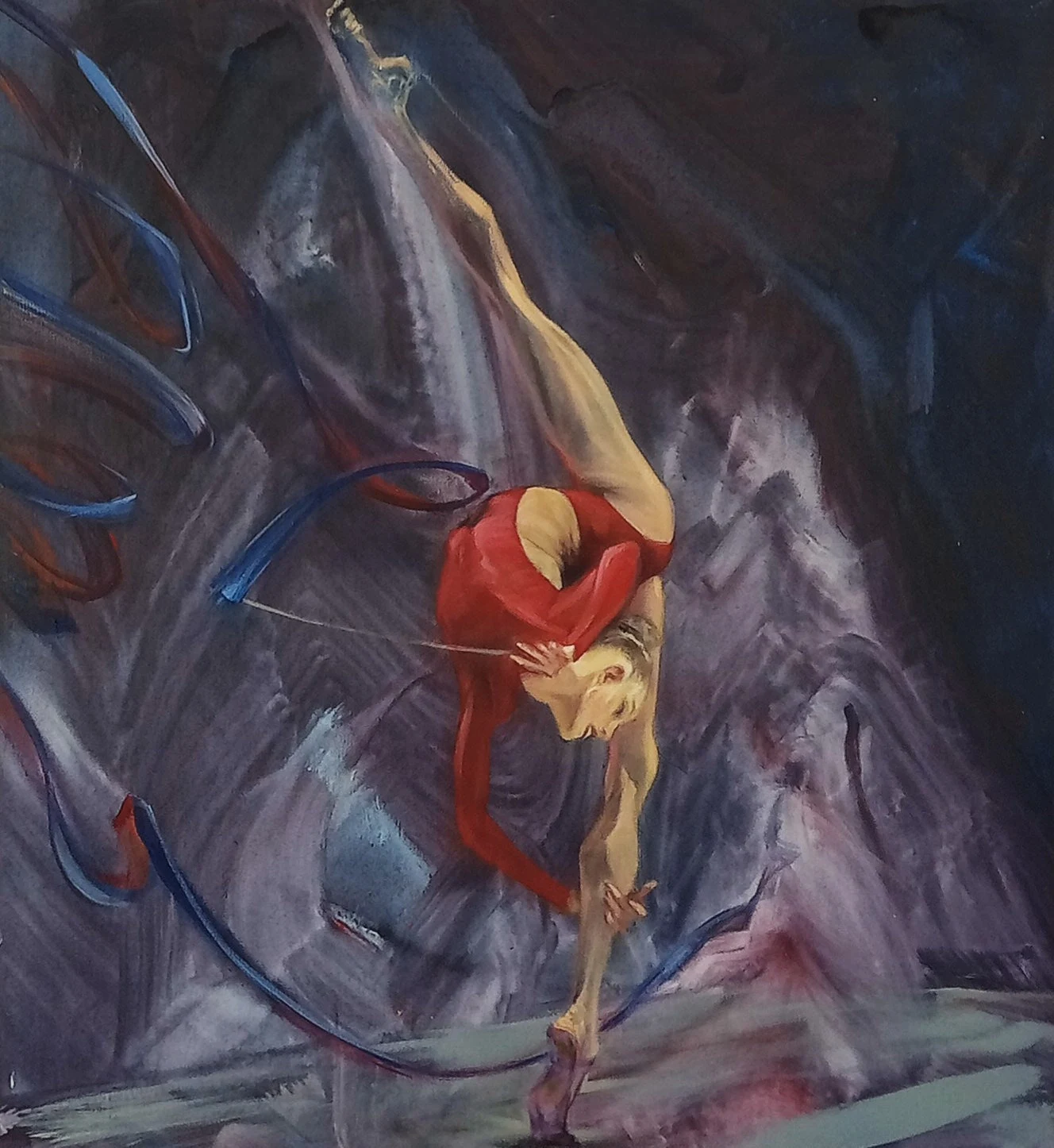
Banner image: ‘Graceful Gymnast’ by Rumen Dimitrov.
- ‘Henry IV’, Part 2 – Act 2, scene 1. By William Shakespeare. ↩︎
- ‘By fire of by force’ is an expression used predominantly in central and west Africa, which means that something will be achieved by any means necessary, come rain or sunshine, come hell or hight water. It means that no matter what happens, how many obstacles or how long the passage of time, that thing will be achieved; it will surely be accomplished. ↩︎


Talk to me. I am curious about your thoughts.